[vc_row][vc_column][vc_column_text]Presented at the Western Winter Workshop on March 6-9, 2025, Carlsbad, CA
Schedule delay analysts aim to improve the accuracy and reliability of their techniques while balancing the need to support their client’s interests. With multiple accepted methods available, different analysts may reach different conclusions. In this presentation, PMA’s CEO Emeritus Dr. Gui Ponce de Leon and Managing Director Dr. Vivek Puri bring consensus to the approach using an algorithmic implementation to ensure accuracy and reproducibility.
Understanding the History and Evolution of Delay Analysis
For decades, forensic schedulers have faced significant challenges when attempting to evaluate project delays accurately. Traditionally, instead of updating the original schedule with the latest progress, schedulers would manually create a simplified version, using methods such as comparing the planned schedule to the actual one. Alternatively, they would collapse parts of the schedule to measure delays. These methods, while useful, often fail to capture the full complexity of project timelines and the effects of delays.
However, in the early 2000s, a shift occurred. Time impact methods began gaining popularity, particularly those that use project management software to reprocess archived schedules and analyze what should have happened. This marked a turning point where collapsed as-built methods gave way to more sophisticated software-driven approaches.
The presentation explains how this evolution laid the groundwork for the revolutionary idea of as-built schedule compression.
The Limitations of the Critical Path Method (CPM) in Delay Analysis
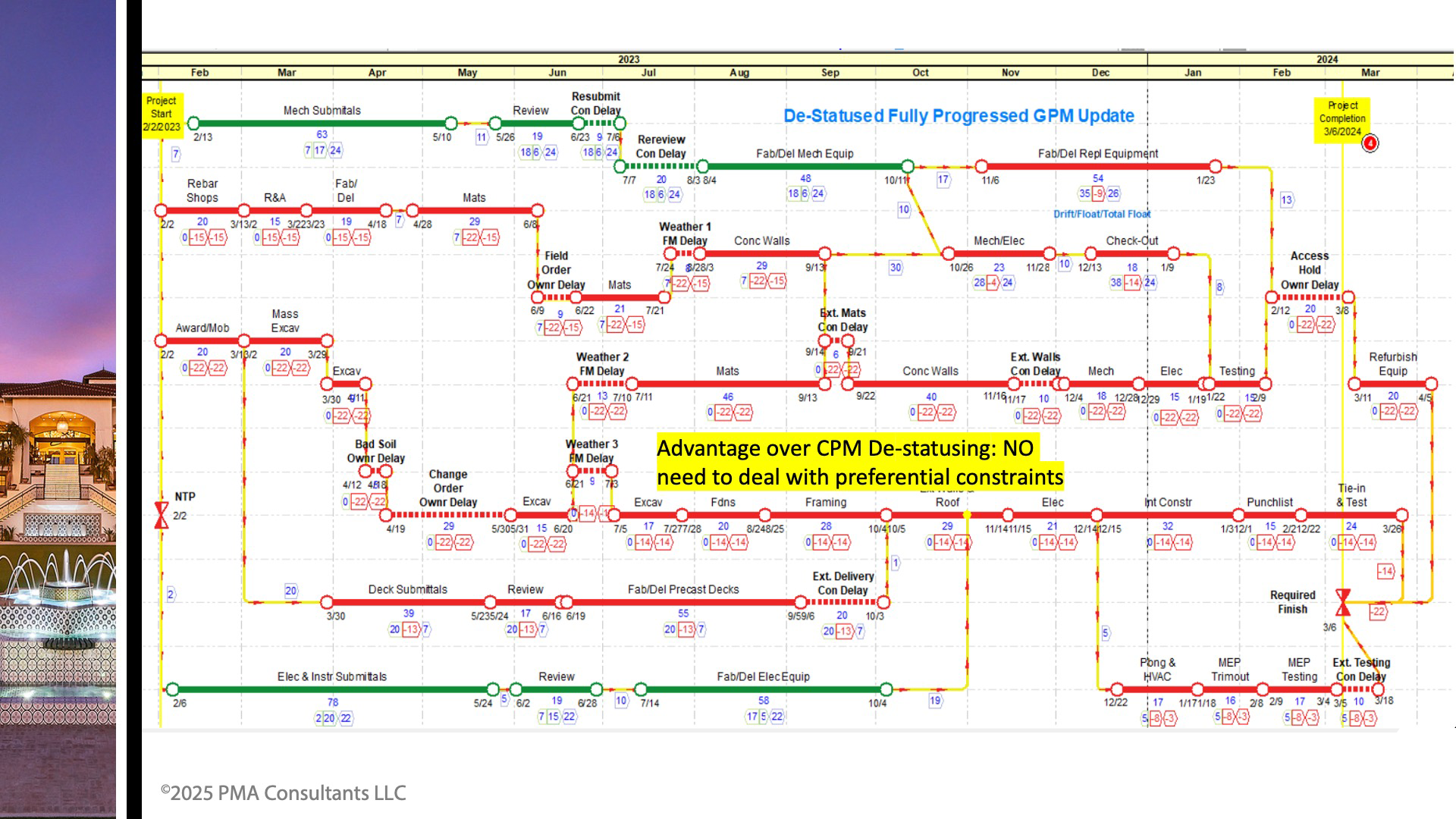
Understanding how the Critical Path Method (CPM) has traditionally been used in delay analysis is essential for appreciating the breakthroughs discussed in the presentation. CPM software has been the industry standard for managing project schedules. However, it has inherent limitations when calculating the left side of the data date, which is the period before the project update or the progress status date.
To address this, the U.S. Army Corps of Engineers’ Modification Impact Evaluation Guide (USACE 1979) required up-to-date CPM schedules to forecast the impact of contract modifications. This idea became central to the theory that a well-prepared CPM schedule, kept current with progress, can reasonably predict the impact of delays on a project’s completion date.
The Graphical Path Method (GPM)
Our core premise is that a CPM schedule’s early finish date is not an accurate reflection of delay impacts on the completion date. Instead, the solution lies in the Graphical Path Method (GPM).
Unlike CPM, which relies on early and late dates to calculate critical paths and total floats, GPM uses a more dynamic approach based on link gaps. A gap on a link indicates the extent to which a predecessor activity can be delayed without delaying its successor. This algorithmic distinction simplifies delay analysis and offers a far more accurate representation of project timelines.
Learn how GPM scheduling algorithms outperform CPM in several key areas:
Planned Dates: GPM calculates planned dates that reflect pre-consumed total float before an activity even starts.
Late Dates: GPM calculates late dates that reveal unused total float, helping to track how delays may be absorbed within the schedule.
As-Built Total Floats & Critical Paths: GPM delivers a more accurate view of the project’s as-built total floats and critical paths, adjusting for the delays already incurred. As the project progresses, the critical path is updated from project start to end, so, unlike CPM, no additional effort is required.
By adopting GPM, delay analysts can move beyond the limitations of CPM, offering better insight into delays and potential project completion dates. The ability to algorithmically adjust for delays in a fully progressed schedule represents a major leap forward in forensic schedule analysis.
Addressing the Longest Path Theory
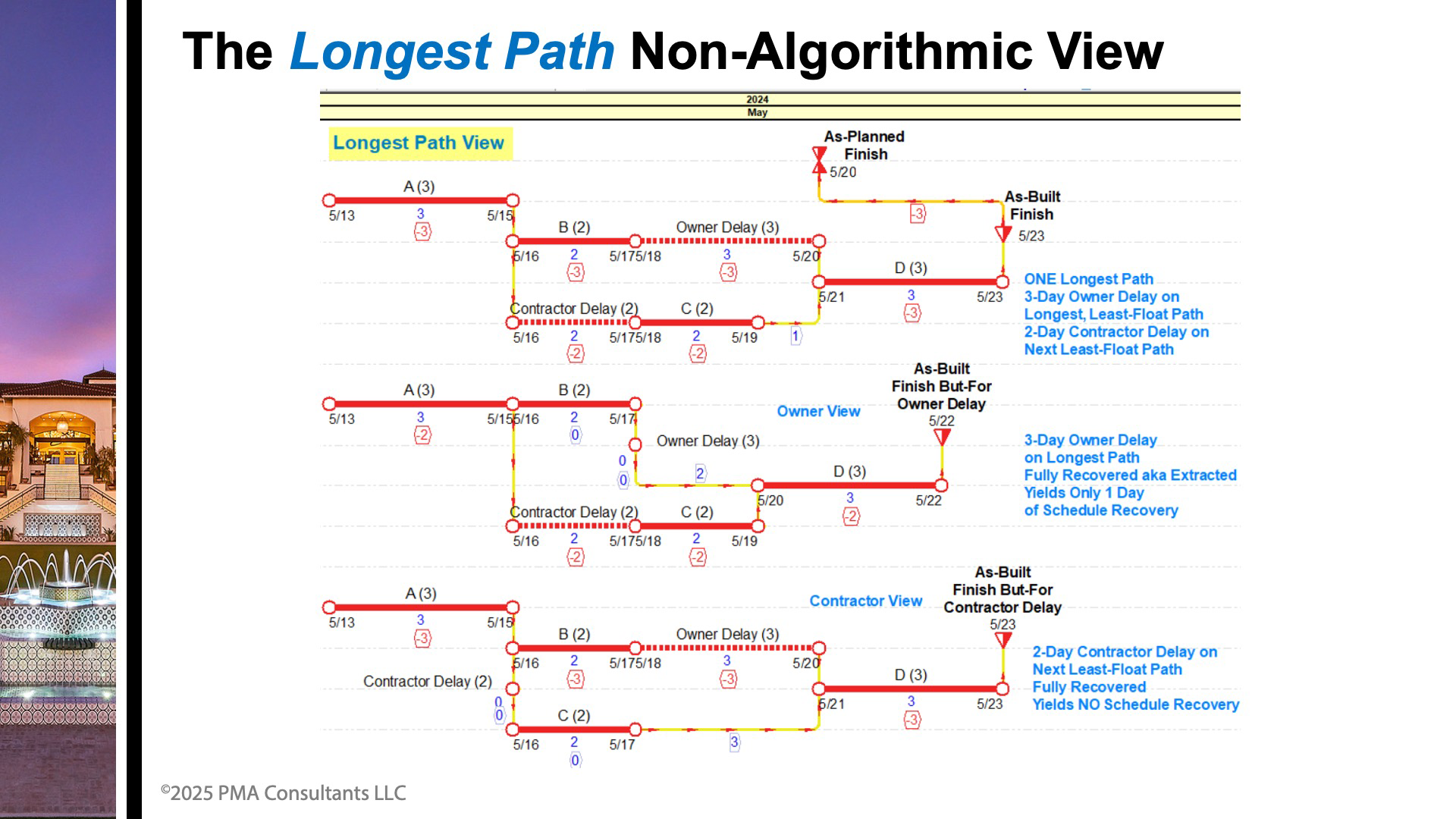
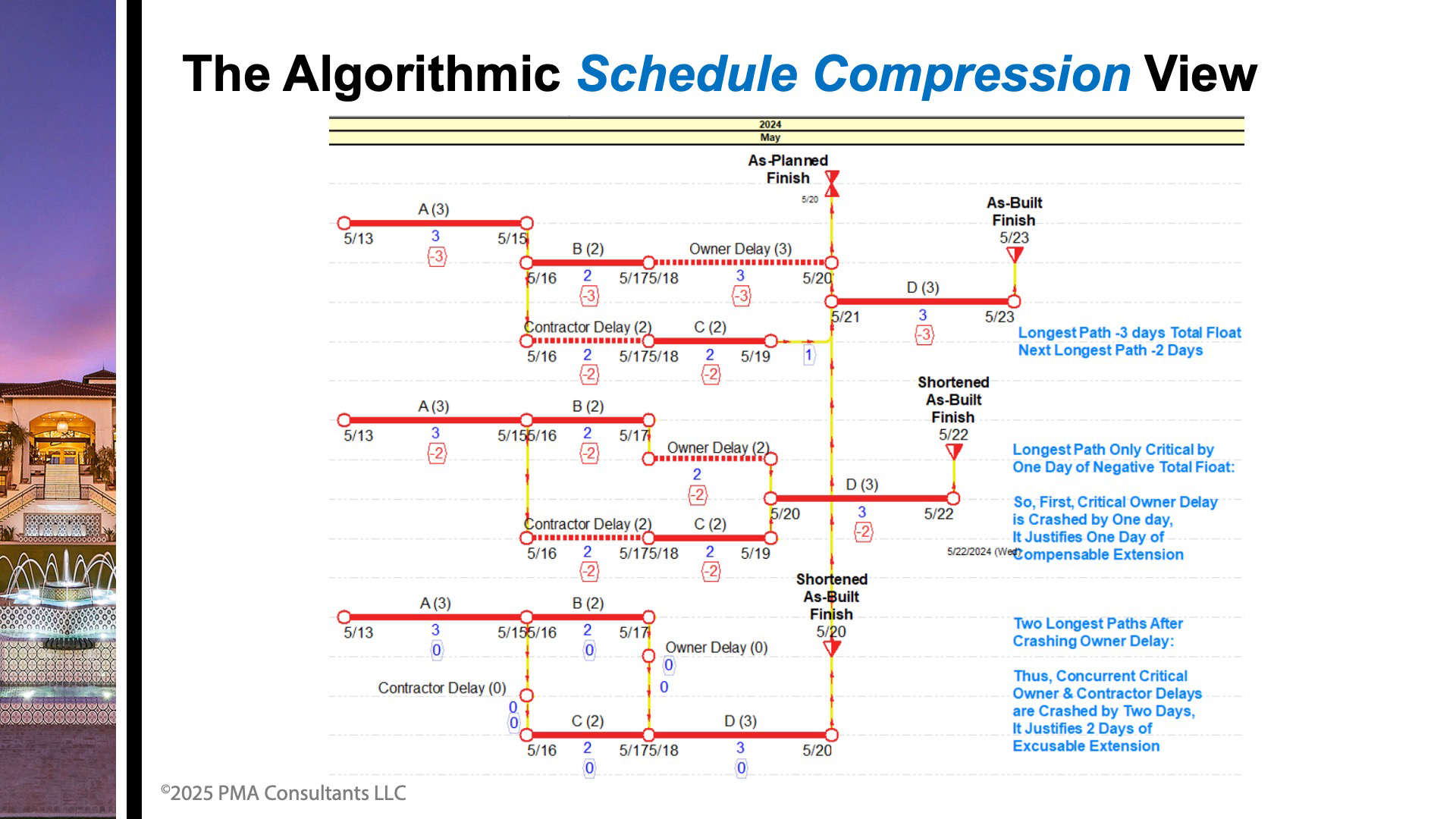
Another important aspect covered in the presentation is the flaw in the longest path theory, which is often relied upon in delay analysis. Dr. Gui and Dr. Vivek uncover why this theory doesn’t always provide an accurate picture of delay impacts and how GPM offers a more precise method of calculating delays.
GPM as the Future of Delay Analysis
CPM schedules often show one of many possible outcomes for a project, but they fail to predict delays and completion dates with reasonable certainty. When a delay occurs on the critical path, simply equating this delay to a direct impact on the project completion date is based on a flawed assumption.
Dr. Gui and Dr. Vivek offer two algorithmically correct ways to quantify delay impact:
- Contemporaneous Statistical Analysis: This approach calculates the probable impact by analyzing the drop in the completion date’s P-value.
- Post-Completion Analysis Using GPM: This method involves extracting the impact from the fully progressed schedule through as-built schedule compression powered by the Graphical Path Method.
By understanding and applying GPM, schedule delay analysts can vastly improve the accuracy of delay impact assessments. GPM provides a significant advancement over traditional CPM-based methods, offering better insights, more reliable predictions, conflict reduction, and greater confidence in delay analysis.
Next Read: Prioritizing Risks During Schedule Risk Analysis
[/vc_column_text][vc_btn title=”download the presentation” style=”outline” shape=”square” color=”black” css=”” link=”url:https%3A%2F%2F2023050.fs1.hubspotusercontent-na1.net%2Fhubfs%2F2023050%2FWWW%2520Solving%2520The%2520Delay%2520Problem%252025%2520Feb%252025%2520Submitted.pdf|target:_blank”][/vc_column][/vc_row]