Transforming Airport Infrastructure with Progressive Design-Build
FIFA World Cup 2026 mandates an aggressive project timeframe for Alaska Airlines
PMA Senior Director Nick Gendron leads company teams on key endeavors. He is currently working on Alaska Airlines’ North Main Terminal Redevelopment Program (NMTRP) at Seattle-Tacoma International Airport. With Seattle hosting six matches in the 2026 World Cup, the project has a firm deadline to upgrade this passenger-facing infrastructure.
The NMTRP presents a notable example of the Progressive Design-Build (PDB) project delivery method. A collaborative approach, flexibility, and potential for better project outcomes have propelled Progressive Design-Build (PDB) to the forefront of project delivery methods.
In a PDB scenario, owners defer finalizing price, schedule, and performance commitments until after the design-build team has been selected and under contract and the design and project risks have been sufficiently defined. Design and construction phases overlap in a progressive design-build approach, allowing for ongoing feedback and adjustments throughout the project. PDB is an optimal solution for complex projects like the NMTRP which requires rapid communication with multiple stakeholders.
Multiple Stages in Progressive Design-Build
PDB projects like the NMTRP proceed in stages with multiple opportunities for an off-ramp. Early stages include the following:
PDB Project Validation Phase
In the project validation phase, the parties have agreed on realistic parameters for the project. The validated scope, schedule, and budget can then be used with collaborative design and construction tools such as design to budget or pull planning to further the design and schedule and develop an accurate maximum cost in the next phase of the project
The Design and Preconstruction Phase
The design-builder provides the owner with real-time, frequent, and transparent cost estimates to ensure that the owner’s budgetary requirements are being met. The design-builder is also frequently updating the project schedule.
When the design has been advanced to an appropriate level of definition that aligns with the owner’s requirements, the design-builder will provide a formal proposal including the overall contract value and project schedule for the final design and construction phase services. The proposal is often provided when the design is approximately 40 to 60 percent complete. At this point, there is an off-ramp where the owner can elect not to proceed.
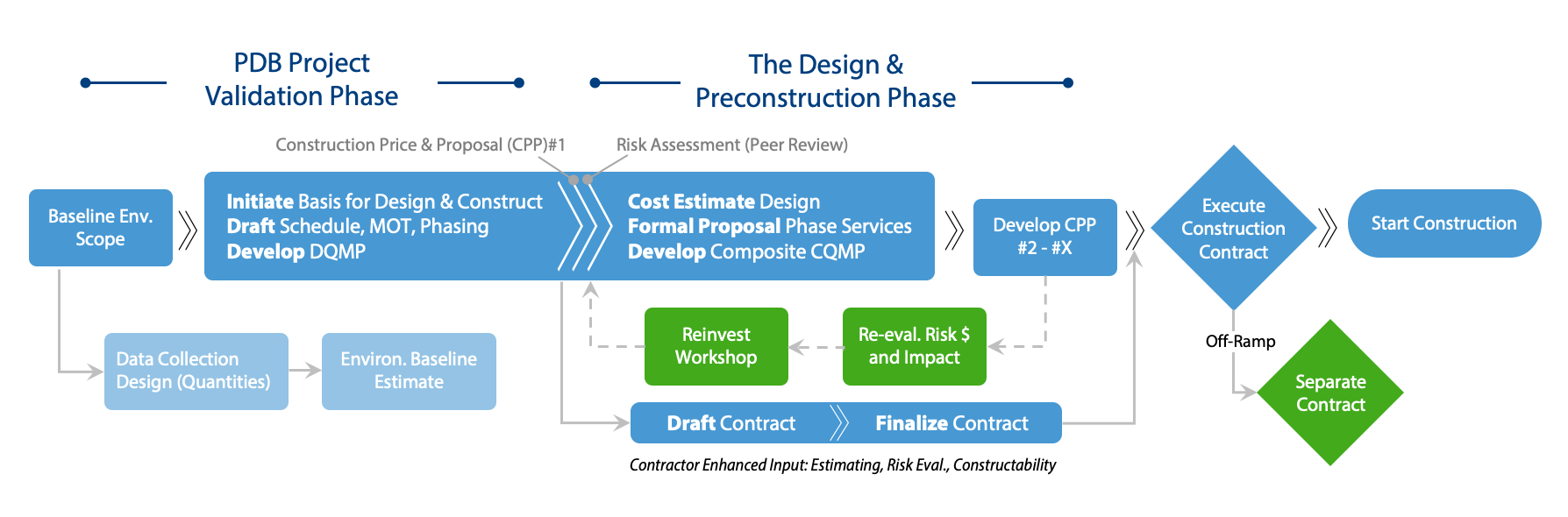
For a closer look at PDB on the Alaska Airlines North Main Terminal Redevelopment Program, we sat down with Nick to discuss his experiences:
At what point in the North Main Terminal Redevelopment Program did PMA start work?
Nick: PMA came in at a very early stage to work on the NMTRP. We came in right after schematic design, which is, hey, we’ve got an idea, and we think that it’s going to look like this, and we want to make sure that we’ve got these features and amenities, and we go from there.’ So, we have gone through every one of the stage gates.
How did PMA’s robust cost management team deliver for Alaska Airlines?
Nick: There’s an agreement between Alaska Airlines and the Port of Seattle where the Port reimburses Alaska Airlines for relevant project costs because the Port of Seattle owns the building, and Alaska Airlines wants this upgrade to be done. Some things the Port of Seattle will pay for, but if there is anything like, say, signs for Alaska Airlines, they will not. So, there is a lot of cost verification going on with every single invoice. Through aggressive cost management, we also answer the important questions of what we have spent and how much progress we have made without going through a more time-consuming earned value management process.
How do the project phases and stage gates work as the project proceeds?
Nick: The gates are an opportunity for the people who hold the money to decide whether they want to continue to pay for the project. On our project, because there was such a significant push to get it done, the stage gates moved very quickly.
The way that it worked on our project was that we would finish the design phase, and all of those design elements would go in front of the various departments. Their architectural design department, their public safety department, etc. ─ all these different departments would see the design as it stood at that moment. We would compile all these comments, and if there were nothing that would really derail the project from moving forward, the Port of Seattle executives would approve more money to be spent.
What is PMA doing during this approval process?
Nick: As the project moves through the stage gates, PMA continues working in the background to push the project forward. We furthered the design and procurement of materials vendors because we knew it would get pushed through the stage gates, and we were going to continue work. However, it took a lot of effort.
How do we see the PDB advantage in action here?
Nick: The great thing about working with a progressive design build contractor is that the design team and the contracting team are the same. As the design team was going through the process of releasing the design to the Port of Seattle, getting comments, responding to those comments, and then getting approval to go into the next stage, the contractor─which is also the designer─was already working on getting subcontractors or procuring materials, and so the process never really stops. That’s the progressive part. As they are reviewing design, construction is moving forward, and planning continues. It’s a really great way to get a project done.
What have been some challenges in this process?
Nick: Documenting all of that has been it’s been a challenge. But it’s been exciting because it doesn’t stop. It’s just always constant. And I think we have done a good job on this project. We’ve kept up with documentation; we’ve kept up with the design-build contractor. We’ve kept communication open with Alaska Airlines as well as the Port of Seattle.
Are there optimal conditions for utilizing PDB?
Nick: I would say that if we are going to work with an owner who wants to do progressive design-build, you do need an owner who is willing to let go of the reins a little bit. That is very difficult for some owners to do. Owners with these stage gates typically don’t want to move forward until approval at each stage. They don’t want other money to be spent unless they’ve approved it. But the beautiful thing about progressive design-build is if you know that you want this job to be done in a timely manner, this delivery method still allows you to review the design, review dollars spent, and dollars committed.
However, it doesn’t stop the process from happening. A good lesson learned is that you’ve got to be willing to allow the process to continue, and you don’t stop just because you’re unsure about something. You need to move forward because construction has to start. So, it is really a fast-paced process, and you have to keep up with it.
A perfect progressive design-build project would be an office building, where changes are not made as you go. You can fine-tune the details later. A healthcare project might be more difficult because of the checks and balances at every level.
Are there any pitfalls to watch out for?
Nick: Sometimes, people aren’t ready for how fast-paced it is. In our experience, we have seen other projects struggle with this approach. Some of the parties just wanted to take their time with it. They wanted to receive, review, and approve the information, and then the project would go forward; however, with PDB, you’re moving the whole time. As long as our clients can adapt to that, I think it’s a fantastic way to get a job done.
Do you have any comments on the future of PDB and this project in particular?
Nick: The future of progressive design-build looks very good as shown by the progress on this project. We have done such a good job of pushing forward that we intend to deliver this project ahead of time and within budget.
Just in time for the World Cup. Sounds like a game-winning goal, Nick!